The student knew the shapes.
They were playing root, third, and seventh voicings, adjusting them for each chord. The notes reflected the harmony, but the chords were being approached as separate events.
Piano lessons / Larry Lee
Piano lessons shaped around what you hear, how you practice, and the music you want to make.
Inquire about lessonsFirst lesson: 45 minutes · $30
01 / The approach
Listening.
Understanding.
Practice.
A melody you keep returning to. A chord that catches your ear. A piece that asks something new of your hands.
Those interests give us a place to begin. We connect the sound to the musical idea and the physical skill, then put it back into your playing. Your experience and questions help shape the work.
Reading, rhythm, coordination, and touch support what you want to play. Scales and interval patterns become musically satisfying exercises, with a clear purpose in the piece.
Why does a passage sound bright, settled, or unresolved? We connect the impression to harmony, melodic shape, texture, and phrasing. Your observations matter.
Scales, modes, voicings, and voice leading give us a vocabulary to draw from. We try alternatives at the piano and listen to what changes.
A good choice serves the phrase and the situation. We consider the listener, the other players, and the role of the piano. Sometimes the useful decision is to do less.
Learning to connect chords
by following each voice.
From a chord shape
to a connected phrase.
They were playing root, third, and seventh voicings, adjusting them for each chord. The notes reflected the harmony, but the chords were being approached as separate events.
Over a short phrase, the student reasoned through which notes could stay, which could move, and what an altered note would do to the sound. We connected the choices to what the ear could follow.
The student applied it to other sections, chose a starting voicing, and connected the following chords. On another pass, they could make different valid choices.
03 / Background
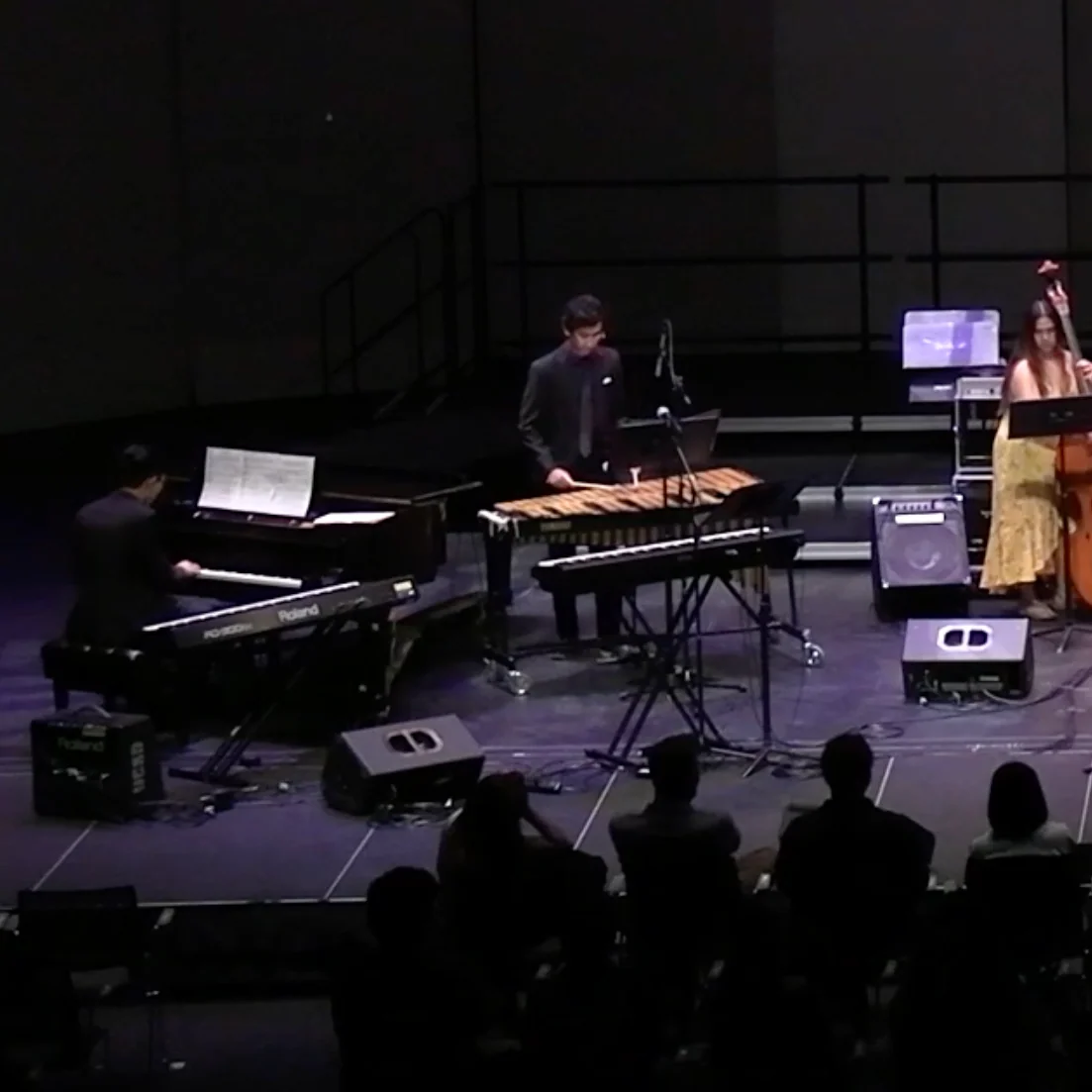
Classical piano is where I began. Jazz opened up another way to understand and participate in music.
I studied classical piano privately for more than ten years. At UC San Diego, I played in the Jazz Ensemble and studied with Grammy-winning producer and pianist Kamau Kenyatta, who co-produced Gregory Porter’s Take Me to the Alley. My coursework included classical theory, counterpoint, jazz improvisation, acoustics, and audio engineering.
I bring that background to the particular student and the music in front of us. Technique and reading remain part of the foundation; harmony and improvisation give us more ways to explore it.
Listen to my work04 / Lesson rates
Your first lesson
45 minutes · $30
One introductory lesson per new student. No package commitment.
For ongoing lessons, choose a lesson length that gives us time for what you’d like to work on.
Per lesson, in USD.
Inquire about lessonsI’m based in San Diego and flexible about lesson format. Include your general location and whether you prefer online or in-person lessons, and we can work out an arrangement.
All experience levels are welcome, from complete beginners to experienced players. We shape the lessons around your background and what you’d like to learn.
Lessons are typically weekly or every other week. Payment is due within seven days after each lesson.
Lessons may be canceled or rescheduled without charge with at least 24 hours’ notice. Late cancellations, late rescheduling, and missed lessons are charged at the full scheduled lesson fee. Makeup lessons are not guaranteed; any courtesy makeup I offer carries no additional charge.
If I cancel a lesson, you won’t be charged. Any payment already made can be refunded or applied to a rescheduled lesson, at your choice.
I’ll reply by email within one to two days so we can discuss your goals, lesson format, and scheduling.
Your playing experience, music you enjoy, and what you’d like to work on. Include your general location and the times that could work for lessons.
Yes. Jazz theory and improvisation are particular areas of interest in my teaching. A piece or lead sheet can give us a practical way into scales, voicings, and phrasing.
The work can include reading, rhythm, coordination, and touch. We connect these foundations to the music you’re learning and identify specific things to practice between lessons.
Tell me what you’re playing and what you’d like to work on.
Inquire about lessons